Loading…
←Back to Planting Guides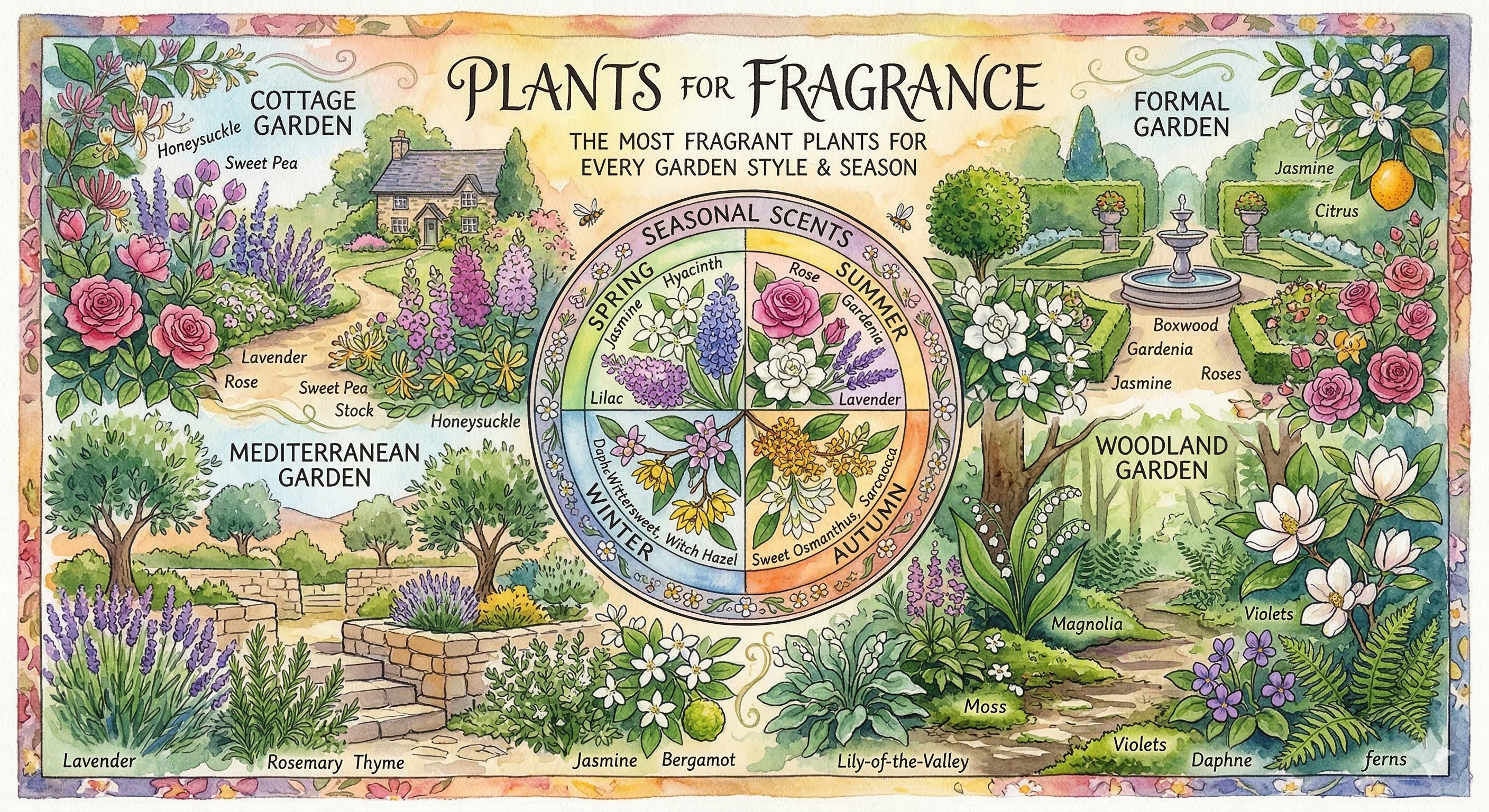


Plants for Fragrance
Written by David Rodgers — Updated March 2026
The Most Fragrant Plants for Every Garden Style and Season
A garden that smells as beautiful as it looks is a garden that reaches beyond the visual and into something deeper — memory, emotion, and pure sensory pleasure. From the heady sweetness of a mid-June rose to the sharp clean scent of crushed lemon thyme, fragrant plants transform outdoor spaces into experiences. This guide covers the best fragrant plants for every garden situation, how to design for scent, and how to keep something blooming and aromatic from the first warm days of spring through the last nights of autumn.
📋 In This Guide▼
- 1.Why Fragrance Should Be Part of Every Garden Design
- 2.Fragrant Plants by Season — Planning a Year of Scent
- 3.The Most Fragrant Shrubs and Trees
- 4.Fragrant Perennials and Groundcovers
- 5.Fragrant Annuals and Climbers
- 6.Designing a Fragrant Garden — Placement, Layering, and Concentration
- 7.Fragrant Plants for Challenging Conditions
- 8.Fragrance Through the Season — Planting Calendar
- 9.Fragrant Vines — Fragrance at Eye and Nose Level
- 10.Fragrant Trees — Whole-Garden Perfume
- 11.The Evening Garden — Plants That Bloom After Dark
- 12.Fragrance Through Every Season
- 13.Regional Fragrance Plant Guide
- 14.Container Fragrance Gardens
- 15.The Fragrant Garden Seasonal Calendar
- 16.Troubleshooting the Fragrant Garden
Why Fragrance Should Be Part of Every Garden Design
Most gardeners plan with their eyes — they choose plants for flower color, foliage texture, and seasonal interest. But scent is the sense most powerfully tied to memory and emotion. The smell of lilacs instantly recalls a childhood yard; the perfume of roses on a warm evening is irreplaceable. Designing with fragrance adds a dimension that photographs can never capture and visitors never forget.
Fragrant plants also do double duty. Many of the best-smelling plants — lavender, catmint, monarda, and echinacea — are among the most powerful pollinator attractors. A fragrant garden is almost always a garden buzzing with bees, butterflies, and beneficial insects. And many aromatic plants, particularly herbs and alliums, naturally repel deer, rabbits, and harmful insects.
The Four Types of Garden Fragrance
| Fragrance Type | How It Works | Best Examples |
|---|---|---|
| Bloom Fragrance | Scent produced by open flowers — the classic garden perfume. Strongest in warm, still air and at peak flowering. Some are only detectable close-up; others carry 20+ feet. | Roses, lilac, gardenia, jasmine, sweet peas, hyacinth, honeysuckle |
| Foliage Fragrance | Released when leaves are brushed, crushed, or warmed by the sun. Present all season, not just at bloom time. | Lavender, rosemary, lemon balm, mint, thyme, catmint, scented geraniums |
| Nocturnal Fragrance | Plants that reserve their scent for evening pollinators (moths). Fragrance intensifies dramatically at dusk. | Four o'clocks, moonflower, night-blooming jasmine, Nicotiana sylvestris, evening primrose, sweet rocket |
| Root/Bark Fragrance | Fragrance from underground structures, wood, or bark — usually only detectable when worked into the soil or cut. Less relevant for garden design. | Sweet flag (Acorus), cedar, sweet cicely |
🌬️
Place the most fragrant plants where air gently circulates around them but is not swept away by strong winds. A sheltered wall or fence behind the plants traps and concentrates scent, creating a fragrance pocket. Avoid open, breezy locations where scent dissipates immediately.
When Fragrant Plants Smell Strongest
- •Warm, humid days — heat opens flowers and volatilizes essential oils; humidity carries scent molecules farther
- •Calm air — wind disperses scent before it can build; sheltered microclimates concentrate fragrance
- •Morning after overnight dew — many flowers refill with nectar and reopen their scent glands at dawn
- •Late afternoon and early evening — the golden hour before sunset is peak time for many roses, lavender, and phlox
- •After light rain — scent compounds are washed to the surface and released as the sun warms wet petals and leaves
Fragrant Plants by Season — Planning a Year of Scent
A well-planned fragrance garden never lacks something blooming and aromatic. Layer these plants to carry scent from the first snowdrops to the final autumn roses.
| Season | Plant | Scent Character | Zones | Notes |
|---|---|---|---|---|
| Early Spring | Hyacinth | Sweet, heavy, classic — the most intensely fragrant spring bulb | 3–9 | Plant in fall; flowers in March–April; excellent in containers by a door |
| Early Spring | Daphne (Daphne odora) | Powerful, sweet, spicy — carries 30+ feet in still air | 7–9 | Slow-growing evergreen shrub; one of the most fragrant plants in existence |
| Early Spring | Viburnum (V. carlesii / V. burkwoodii) | Sweet clove-vanilla — large clusters of white flowers | 4–8 | Reliable, deer-resistant shrub; great for foundations and hedges |
| Mid-Spring | Lilac (Syringa vulgaris) | Classic sweet-floral — the defining scent of May | 3–7 | Needs cold winters to bloom; spectacular for Zones 3–6; many named varieties |
| Mid-Spring | Wisteria | Grape-vanilla sweetness — can perfume an entire yard | 5–9 | Vigorous climber; keep pruned; stunning over pergolas |
| Mid-Spring | Sweet Violets (Viola odorata) | Delicate, fleeting violet sweetness | 4–9 | Naturalizes under shrubs and trees; blooms before leaves emerge |
| Late Spring | Peony | Rich rose-honey-citrus — among the most beloved garden scents | 3–8 | Very fragrant varieties: 'Sarah Bernhardt', 'Festiva Maxima', 'Duchesse de Nemours' |
| Late Spring | Sweet Peas (Lathyrus odoratus) | Intensely sweet and fruity — old-fashioned varieties are far more fragrant than modern types | Annual | Sow in early spring; fragrance declines in heat — succession-sow for longest season |
| Early Summer | Roses (David Austin types) | Complex: Old Rose, myrrh, lemon, spice, honey — depends on variety | 4–9 | See the fragrant rose table below for top-rated varieties |
| Early Summer | Lavender | Sharp, floral-herbal — clean, long-lasting, calming | 5–9 | 'Hidcote', 'Munstead', 'Grosso' — foliage fragrant all season; blooms early summer |
| Midsummer | Garden Phlox (Phlox paniculata) | Sweet vanilla-honey — especially strong in the evening | 4–8 | Full sun; needs good air circulation; extremely attractive to butterflies |
| Midsummer | Gardenia | Intoxicating sweet-cream-tropical — heavy and distinctive | 8–11 | Also excellent in containers brought outdoors in summer (Zones 6–7) |
| Midsummer | Jasmine (Jasminum officinale) | Classic white-flower sweetness — the most recognizable floral perfume | 7–10 | Also excellent in containers; night-blooming varieties peak after dark |
| Midsummer | Monarda / Bee Balm | Spicy-herbal oregano-meets-orange — released from foliage and flowers | 3–9 | Top pollinator plant; resists deer; afternoon sun releases foliage scent strongly |
| Midsummer | Heliotrope | Cherry-vanilla — uniquely distinctive; the scent of vanilla ice cream | Annual | Often sold as a tender perennial; prefers full sun; great in containers |
| Late Summer | Phlox paniculata (late types) | Sweet vanilla — late-blooming types carry fragrance into August | 4–8 | 'David', 'Europa', 'Miss Lingard' bloom later and resist powdery mildew |
| Late Summer | Four O'Clocks (Mirabilis jalapa) | Sweet, lemony — strongest at dusk; ignored by deer and rabbits | Annual | Self-seeds prolifically; forms tuberous roots that can be dug and stored |
| Late Summer | Mexican Sage (Salvia leucantha) | Soft herbal-sage — foliage fragrance all season, not just at bloom | 8–11 / annual | Stunning purple-white late blooms; bring indoors for winter in cold climates |
| Autumn | Witch Hazel (Hamamelis) | Sweet-spicy clove — blooms Nov–Feb; a fragrance miracle in the cold garden | 3–8 | Vase-shaped shrub with spectacular fall color AND winter bloom |
| Autumn | Autumn Joy Sedum (Hylotelephium) | Subtle honey — secondary to its wildlife and structural value | 3–9 | Excellent for cutting; holds structure through winter; loved by bees |
🌸
For a true four-season fragrance experience, begin with a witch hazel (Hamamelis 'Jelena' or 'Arnold Promise') in a sheltered corner — it blooms in January and February when nothing else does, its spicy-sweet scent rising on cold air. Add early hyacinths in pots by the door for March–April, then let the sequence of lilac → peony → rose → phlox → jasmine carry you through spring and summer.
The Most Fragrant Shrubs and Trees
Woody fragrant plants provide the backbone of a scent garden — they return year after year, grow larger and more fragrant with age, and require less work than annuals or perennials. These are the shrubs and small trees with the greatest fragrance impact.
| Plant | Bloom Season | Fragrance Profile | Size at Maturity | Zones | Notes |
|---|---|---|---|---|---|
| Lilac (Syringa vulgaris) | Mid-spring | Classic sweet floral — THE iconic spring scent | 8–15 ft | 3–7 | Needs cold winters; superb cut flower; 'Charles Joly' (double magenta) and 'President Lincoln' (blue) are among the most fragrant |
| Daphne (Daphne odora) | Late winter–early spring | Extraordinary spicy-sweet intensity — carries 30+ feet | 3–4 ft | 7–9 | 'Marginata' has cream-edged leaves; evergreen; one of the most powerfully fragrant small shrubs |
| Viburnum burkwoodii | Mid-spring | Spicy-sweet clove clusters | 8–10 ft | 4–8 | Semi-evergreen; good disease resistance; carries scent in cool spring air |
| Mock Orange (Philadelphus coronarius) | Early summer | Intense orange blossom-jasmine | 6–10 ft | 4–8 | 'Aureus' has golden foliage; deciduous; blooms profusely on older wood — don't over-prune |
| Gardenia (G. jasminoides) | Summer | Heavy, tropical, unmistakable cream-sweet | 2–8 ft (varies by variety) | 8–11 | 'August Beauty' and 'Veitchii' are most fragrant; excellent in containers in cooler zones |
| Summersweet (Clethra alnifolia) | Midsummer | Spicy-sweet clove — blooms when little else does in July–Aug | 3–8 ft | 4–9 | Tolerates wet soil and part shade; deer-resistant; excellent fall color |
| Korean Spice Viburnum (V. carlesii) | Mid-spring | Sweet clove-vanilla — very strong carrier | 4–6 ft | 4–7 | Compact; one of the most fragrant spring shrubs for small gardens |
| Sweet Olive (Osmanthus fragrans) | Autumn–winter | Apricot-peach sweetness — small flowers with massive scent | 6–30 ft | 8–11 | The tea-olive of Southern gardens; container-grown specimen in cooler climates |
| Witch Hazel (Hamamelis 'Jelena') | Jan–Feb | Spicy-sweet copper-orange — midwinter miracle | 10–15 ft | 3–8 | Also spectacular fall color; the only shrub that blooms and smells beautiful in mid-winter |
| Chaste Tree (Vitex agnus-castus) | Late summer | Herbal-spicy lavender-like — both flowers and foliage | 10–20 ft | 6–9 | Excellent for hot climates; blooms Aug–Sept; loved by bees; cut back hard each spring |
| Wisteria (floribunda or sinensis) | Late spring | Grape-vanilla sweetness — can perfume an entire garden | Vine: 20–30 ft | 5–9 | Requires strong support; blooms on old wood; prune twice a year; Japanese wisteria most fragrant |
🏡
Plant mock orange (Philadelphus) or lilac near a bedroom window or back-porch seating area. Both bloom in late spring–early summer and will perfume interior spaces through open windows on still evenings — a feature that no amount of décor can replicate.
Fragrant Roses — The Crown Jewels of the Scent Garden
Roses are the most complex and beloved fragrant plants in cultivation. Modern hybrid teas often have little to no scent, but old garden roses and David Austin English roses have retained the rich, multi-layered fragrances that made roses prized throughout history. When choosing for fragrance, always smell before you buy — descriptions help, but individual response to scent is subjective.
| Rose Variety | Type | Fragrance Profile | Zones | Notes |
|---|---|---|---|---|
| Gertrude Jekyll | David Austin shrub | Rich, classic Old Rose — deep, warm, and complex; one of the finest rose fragrances in existence | 5–9 | Deep pink; 4–5 ft shrub or short climber; can also be trained on a wall; repeat-flowering |
| Munstead Wood | David Austin shrub | Warm: blackberry, damson plum, Old Rose base — very strong | 5–9 | Deep crimson-velvety; compact 4 ft; excellent repeat; disease-resistant |
| Madame Isaac Pereire | Old garden / Bourbon | Perhaps the most powerfully fragrant rose ever bred — raspberry, damask, rich and overwhelming | 5–9 | Large shrub or climber; rich magenta-pink; fall rebloom is best season for scent |
| Tuscany Superb | Old garden / Gallica | Classic deep damask — velvety, complex, ancient-smelling | 4–9 | Deep crimson-purple; blooms once in June; nearly thornless; tolerates some shade |
| The Generous Gardener | David Austin climber | Old rose, musk, and myrrh — strong and distinctive | 4–9 | Pale pink; elegant water-lily blooms; up to 12 ft; superb on arches and pergolas |
| Climbing Cecile Brunner | Old garden climber | Sweet, light, tea rose — delicate but carries in still air | 5–9 | Tiny pink flowers in large clusters; vigorous to 20 ft; nearly thornless; blooms once |
| Falstaff | David Austin shrub | Rich Old Rose — very strong; one of the deepest crimson Austin roses | 5–9 | Crimson-scarlet fading to purple; fully double cups; excellent repeat |
| Princess Alexandra of Kent | David Austin shrub | Fresh tea evolving to lemon-blackcurrant — one of Austin's most complex scents | 5–9 | Warm pink; compact 3.5 ft; outstanding in containers; excellent disease resistance |
| Scentimentally (climber) | Modern climber | Strong spicy-fruity — unusual striped red-cream flowers with real scent | 5–9 | Produces large striped blooms repeatedly; good disease resistance for a striped rose |
| Souvenir de la Malmaison | Old garden / Bourbon | Spicy-sweet damask — the rose that defined Victorian fragrance | 6–9 | Blush-cream; flat quartered flowers; rain can ball the blooms; climbing form available |
Fragrant Perennials and Groundcovers
Perennial fragrant plants come back year after year, often spreading to fill larger areas and becoming more fragrant with maturity. These reliable performers provide the structural scent layer of any garden.
| Plant | Scent Type | Bloom Season | Height | Zones | Notes |
|---|---|---|---|---|---|
| Lavender (Lavandula angustifolia) | Herbal-floral — classic, calming, long-lasting | Early summer | 18–24 in | 5–9 | 'Hidcote' and 'Munstead' most fragrant; foliage scented all season; excellent cut and dried |
| Garden Phlox (Phlox paniculata) | Sweet vanilla-honey — carries 15+ feet in evening | Mid–late summer | 2–4 ft | 4–8 | Choose mildew-resistant varieties: 'David', 'Eva Cullum'; needs sun and airflow |
| Peony (Paeonia lactiflora) | Rose-honey-citrus — some varieties overwhelmingly fragrant | Late spring | 2–3 ft | 3–8 | Most fragrant varieties: 'Sarah Bernhardt', 'Festiva Maxima', 'Duchesse de Nemours' |
| Russian Sage (Perovskia atriplicifolia) | Sage-lavender herbal — strong foliage scent all season | Late summer | 3–5 ft | 4–9 | Silvery stems; drought-tolerant; hazy blue flowers; excellent with ornamental grasses |
| Catmint (Nepeta 'Walker's Low') | Spicy, slightly minty herbal — released by touch | Late spring–autumn | 18–24 in | 3–8 | Loved by bees and cats; deadhead after first flush for continuous bloom; very deer-resistant |
| Monarda / Bee Balm | Spicy oregano-orange — foliage and flowers | Midsummer | 2–4 ft | 3–9 | 'Jacob Cline' (red) and 'Marshall's Delight' (pink) resist powdery mildew best |
| Sweet Woodruff (Galium odoratum) | Vanilla-hay — dried foliage smells of fresh mown hay | Spring | 6–12 in | 4–8 | Shade-tolerant groundcover; excellent under trees; used to flavor May wine |
| Dianthus / Garden Pinks | Spicy clove — the classic 'carnation' scent | Late spring–summer | 6–18 in | 3–9 | Old-fashioned varieties far more fragrant than modern cultivars; 'Mrs. Sinkins' and 'Dad's Favourite' |
| Hemerocallis (fragrant types) | Sweet citrus-rose — only specific varieties | Summer | 18–30 in | 3–9 | Most fragrant: 'Hyperion', 'Stella de Oro', 'Happy Returns'; not all daylilies are scented |
| Lily (Lilium orientale / trumpet) | Heavy, tropical sweet — one of the strongest summer scents | Mid–late summer | 3–6 ft | 4–8 | Oriental types: 'Stargazer', 'Casa Blanca'; Trumpet types: 'African Queen'; must have good drainage |
| Agastache (Hyssop) | Anise-licorice herbal — foliage very strongly scented | Summer–autumn | 2–4 ft | 5–9 | Loved by hummingbirds and butterflies; drought-tolerant; 'Blue Fortune' most reliable |
| Thyme (Thymus) | Herbal, warm, slightly medicinal — strongest in sun | Late spring | 2–12 in | 4–9 | Creeping thyme excellent between pavers — releases scent underfoot; 'Lemon' thyme most fragrant |
🌿
Not all lavender varieties carry the same fragrance intensity. 'Lavandin' hybrids (Lavandula × intermedia) like 'Grosso' are more vigorous and produce more essential oil, making them the most fragrant for culinary use and sachets. True lavender (L. angustifolia) types like 'Hidcote' and 'Munstead' are better for garden borders and have a finer, sweeter scent. Always check the species when buying lavender for fragrance.
Fragrant Annuals and Climbers
Annual fragrant plants fill gaps between perennials and provide some of the most intense scents in the garden — often out-performing woody plants. Climbers extend fragrance upward and outward, allowing scent to drift from a pergola, fence, or arch.
| Plant | Type | Scent Profile | Season | Notes |
|---|---|---|---|---|
| Sweet Peas (Lathyrus odoratus) | Annual climber | Intensely sweet, complex fruity-floral — old-fashioned varieties only | Spring–early summer | Choose heritage varieties: 'Painted Lady', 'Matucana', Spencer types. Fragrance declines in heat — great for cool-spring climates (Zones 3–7) |
| Moonflower (Ipomoea alba) | Annual climber | Sweet, tropical, vanilla-floral — peak at dusk; flowers last one night | Midsummer–frost | Brilliant white dinner-plate blooms open at sunset; plant near evening seating for maximum effect |
| Nicotiana sylvestris | Annual | Sweet jasmine-tobacco — extremely strong, especially at night | Summer–frost | Tall (4 ft); tubular white flowers; attracts moths; far more fragrant than compact N. alata types |
| Sweet Alyssum (Lobularia maritima) | Annual | Honey — light, delicate, pervasive | Spring–frost | Spreads to fill path edges and container tops; cool-season lover; self-seeds freely |
| Heliotrope (Heliotropium arborescens) | Tender perennial / annual | Cherry vanilla — unique and distinctive | Summer–frost | Plant in full sun containers near seating; 'Black Beauty' and 'Marine' most fragrant; bring inside for winter |
| Four O'Clocks (Mirabilis jalapa) | Annual / tender perennial | Lemony-sweet — very strong at dusk and evening | Midsummer–frost | Opens in late afternoon; deer-resistant; forms tuberous roots that can be overwintered like dahlias |
| Stock (Matthiola incana) | Cool-season annual | Rich, spicy-sweet old-fashioned clove — very strong | Spring / autumn | Grow in cool weather (spring or fall); fragrance lost in summer heat; excellent cut flower |
| Jasmine (Jasminum officinale) | Tender climber | Classic sweet white jasmine — one of the most recognizable floral scents | Summer–autumn | Hardy to Zone 7; container-grown in cooler areas; the white star flowers produce the iconic perfume |
| Honeysuckle (Lonicera periclymenum) | Hardy climber | Sweet, fruity-honey — strongest in evening | Early–midsummer | 'Serotina' (late Dutch) and 'Graham Thomas' — excellent fragrance; train on arbors and fences |
| Chocolate Vine (Akebia quinata) | Hardy climber | Vanilla-chocolate spice — subtle but distinctive | Spring | Vigorous semi-evergreen; small chocolate-purple flowers; can be aggressive in warm climates |
| Wisteria (annual substitute: Dolichos lablab) | Annual climber | Sweet pea-like; light | Summer | For Zones where wisteria doesn't thrive; purple-pink fragrant flowers; edible pods |
🌙
Build a "Moon and Scent" corner in your garden with evening-fragrant plants: moonflower on a trellis, four o'clocks in front, Nicotiana sylvestris behind, and a pot of night-blooming jasmine on the patio. This seating area transforms entirely after 6 PM, filling with fragrance that is almost undetectable during the day.
Recommended Product
Old-Fashioned Sweet Pea Seed Collection — Heirloom Fragrant Varieties
Heritage sweet pea varieties that carry the intense fragrance of old-fashioned garden peas. Modern F1 hybrids have largely lost their scent — these are the real thing.
- ✓Spencer and Grandiflora types with true sweet pea fragrance
- ✓Heirloom seed — open-pollinated, save seeds each year
- ✓Early, mid, and late-season varieties for extended bloom
- ✓Excellent for cutting — the more you cut, the more they bloom
Affiliate link — we may earn a small commission at no extra cost to you.
Designing a Fragrant Garden — Placement, Layering, and Concentration
Fragrance is as much about placement as plant selection. The most intensely perfumed plant in the wrong location contributes little; a moderately fragrant plant in exactly the right spot can transform the entire garden experience.
The Seven Rules of Fragrant Garden Design
- •Plant near paths, gates, and doorways — People slow down and stop at transitions. A fragrant shrub flanking a garden gate or a row of lavender along a path means every visitor encounters scent. Plant mock orange, lavender, or dianthus within arm's reach of well-trafficked routes.
- •Place seating within a scent pocket — A chair positioned 6–10 feet downwind of a rose or phlox border will always be fragrant. Consider prevailing wind direction and site your outdoor seating accordingly.
- •Use walls and fences as fragrance traps — A south- or west-facing wall absorbs heat, radiates it back to nearby plants, and creates a sheltered pocket where scent accumulates rather than dispersing. Plant climbing roses, jasmine, or honeysuckle against warm walls.
- •Layer by fragrance type — Combine bloom fragrance (roses, phlox), foliage fragrance (lavender, catmint), and nocturnal fragrance (moonflower, four o'clocks) in the same area for all-day, all-season scent interest.
- •Put foliage-fragrant plants at elbow and knee height — Lavender, catmint, scented geraniums, and thyme release their best fragrance when brushed. Plant them at the edge of paths where clothing and hands naturally make contact.
- •Consider the view from inside — A fragrant climbing rose or jasmine positioned just outside a frequently opened window carries its scent into interior living spaces, extending the garden experience indoors.
- •Don't mix too many strong scents in one area — Competing heavy fragrances cancel each other out. In a small space, choose one dominant perfume (roses) and complement with lighter, different-character scents (thyme, sweet alyssum) rather than stacking several heavy hitters.
| Garden Location | Best Fragrant Plants | Reason |
|---|---|---|
| Front door / entry | Daphne, Korean Spice Viburnum, lavender in pots, hyacinth in spring | Every visitor experiences the greeting scent; containers allow year-round management |
| Garden gate or arch | Climbing rose ('The Generous Gardener'), honeysuckle, sweet peas | Arch concentrates scent overhead as people pass through; creates a scent threshold |
| Patio / seating area | Heliotrope in pots, phlox, jasmine on nearby fence, lavender in border | People are stationary here — passive fragrance diffuses naturally |
| Bedroom window | Mock orange, lilac (if zone-appropriate), climbing rose, jasmine | Evening breeze carries night-scented flowers into sleeping spaces |
| Garden path edges | Thyme, catmint, sweet alyssum, dianthus, lavender | Brushed by legs and feet; foliage fragrance released with every step |
| Fence or wall (south-facing) | Climbing rose, wisteria, jasmine, honeysuckle | Wall heat intensifies bloom and concentrates scent in the air pocket next to it |
| Evening seating area | Moonflower, four o'clocks, Nicotiana sylvestris, evening primrose | Nocturnal plants peak after sunset — locate near where you spend summer evenings |
Fragrant Plants for Challenging Conditions
Not every garden has full sun and rich soil. These fragrant plants succeed in difficult conditions that rule out many other aromatic plants.
Fragrant Plants for Shade
- •Sweet Woodruff (Galium odoratum) — Vanilla-hay scent; thrives in deep shade under trees; forms a weed-suppressing carpet; Zones 4–8
- •Sweet Violets (Viola odorata) — Delicate violet scent in early spring; naturalizes happily in part shade; Zones 4–9
- •Lily of the Valley (Convallaria majalis) — Famously sweet bell-flower scent; spreads vigorously in shade; all parts toxic; Zones 2–7
- •Daphne 'Carol Mackie' — Variegated-leaf daphne; tolerates more shade than most; light spicy-sweet fragrance; Zones 4–9
- •Solomon's Seal (Polygonatum odoratum) — Subtle, light honey scent from small pendant bells; elegant woodland plant; Zones 3–8
- •Actaea / Snakeroot (Cimicifuga) — Musky-vanilla scent from tall white bottlebrush spires in late summer shade; Zones 3–8
Fragrant Plants for Dry Conditions
- •Lavender — Perhaps the most drought-tolerant fragrant plant; excellent on dry, sandy, alkaline soils; Zones 5–9
- •Catmint (Nepeta) — Strongly aromatic; very drought-tolerant once established; thrives on neglect; Zones 3–8
- •Rosemary — Powerful resinous herbal scent; extremely drought-tolerant in Zones 7–11; tender annual/container in cooler zones
- •Russian Sage (Perovskia) — Sage-lavender herbal; thrives in hot, dry, alkaline conditions; stunning in late summer; Zones 4–9
- •Agastache — Anise-licorice; naturally drought-adapted prairie plant; extremely fragrant foliage; Zones 5–9
- •Rugosa Rose — Powerfully fragrant with clove-rose scent; tolerates sandy, coastal, and dry soils; excellent disease resistance; Zones 2–9
Fragrant Plants for Containers
- •Gardenia — Spectacular in containers in Zones 6–7; bring indoors for winter; needs acidic soil mix; most fragrant of all container plants
- •Heliotrope — Cherry-vanilla; excellent compact container plant; bring indoors to overwinter; full sun essential
- •Scented Geraniums (Pelargonium) — Rose, lemon, mint, nutmeg, and ginger varieties; foliage fragrant all season; overwinter as houseplants
- •Jasmine — Night-blooming jasmine (Cestrum nocturnum) or star jasmine; excellent in large pots; bring indoors in winter (Zone 7 and colder)
- •Hyacinth — Spring bulb; spectacular in pots by a front door; one of the most powerful garden fragrances
- •Dwarf Lilac 'Palibin' — Compact Meyeri lilac; can be grown in a large pot; sweet spring fragrance; Zones 3–7
🪴
Scented geraniums (Pelargonium) are among the most underused fragrant container plants. Unlike flowering geraniums, the scent comes from the foliage — rub a leaf of lemon, rose, or nutmeg geranium and enjoy an intensely aromatic experience that lasts for minutes. They thrive in containers, need minimal water, and can be cut back hard and brought indoors for winter in any climate.
Fragrance Through the Season — Planting Calendar
This calendar uses Zone 7 as a reference point (last frost mid-April, first frost mid-November). Shift timing approximately 2–3 weeks later per zone colder, or 2–3 weeks earlier per zone warmer.
| Month | What's Fragrant (Zone 7 reference) | Key Tasks |
|---|---|---|
| January–February | Witch hazel (if planted), Daphne odora (in warmest spots) | Order fragrant seeds (sweet peas, nicotiana, heliotrope, four o'clocks); start sweet peas indoors 8–10 weeks before last frost |
| March | Daphne, early hyacinth (pots), sweet violets, early viburnum | Direct-sow sweet peas outdoors in Zone 7+; transplant sweet pea seedlings in Zone 5–6 after last frost passes |
| April | Hyacinth, narcissus (fragrant types), lilac begins, sweet violets, viburnum | Plant out lavender, catmint, dianthus transplants; direct-sow sweet alyssum; plant patio roses in containers |
| May | Lilac peak, peony, wisteria, dianthus, Korean Spice Viburnum, mock orange begins, sweet peas in cool zones | Plant out heliotrope, nicotiana, four o'clock seedlings after frost; deadhead spring bulbs; plant jasmine and climbing roses |
| June | Roses peak, mock orange, lavender begins, sweet peas (cool zones), dianthus, peonies ending | Deadhead roses after first flush to encourage rebloom; take lavender cuttings; plant moonflower seeds outdoors |
| July | Lavender peak, phlox begins, monarda, agastache, honeysuckle, heliotrope, sweet alyssum, Nicotiana sylvestris | Water fragrant annuals consistently; deadhead phlox to prevent mildew and encourage rebloom; harvest lavender for drying |
| August | Phlox, roses rebloom, agastache, Russian sage, four o'clocks, moonflower, heliotrope, jasmine | Take cuttings of scented geraniums, heliotrope for overwintering; order spring bulbs (hyacinth, narcissus) for fall planting |
| September | Autumn joy sedum, roses final flush, agastache, phlox ending, four o'clocks, sweet olive (Zone 8+) | Plant spring fragrant bulbs (hyacinth, narcissus); plant viburnum, witch hazel, lilac — fall is best time for woody plants |
| October | Sweet olive (Zone 8+), autumn roses, asters | Bring in heliotrope, gardenia, jasmine before frost; plant forced hyacinth bulbs in pots for indoor winter bloom |
| November–December | Witch hazel begins (Zone 6+), Christmas box (Sarcococca) | Order seeds for next year; plan fragrance layering changes; force hyacinth bulbs in cool space for January bloom |
✂️
Cutting fragrant flowers at their peak — before they've been fully pollinated and begin to decline — is the single best way to bring garden fragrance indoors and extend flowering on the plant simultaneously. Roses, peonies, phlox, sweet peas, and lavender all benefit from regular cutting. Keep a small vase on the kitchen counter through the season and your indoor spaces will share the garden's fragrance.
Fragrant Vines — Fragrance at Eye and Nose Level
Fragrant vines are among the most effective tools in the scented garden because they place fragrance exactly where people are — at face height on a fence, around a doorway, over an arbor or pergola where people sit and gather. A fragrant vine over a garden gate or porch creates an arrival experience that no other plant category can match.
🌼 Wisteria (Wisteria spp.)
Wisteria in full bloom is perhaps the single most dramatic fragrant plant in temperate horticulture. The cascading purple-blue racemes on a mature plant, combined with a sweet, penetrating, grapey-vanilla fragrance that carries across an entire property, create an experience that stops people in their tracks.
- •Best fragrant species: W. sinensis (Chinese wisteria) and W. floribunda (Japanese wisteria) are the most fragrant and the most vigorous. American wisteria (W. frutescens 'Amethyst Falls,' 'Nivea') and Kentucky wisteria (W. macrostachya 'Blue Moon,' 'Clara Mack') are less aggressive, more reliably fragrant in cold climates (to Zone 3), and recommended for gardeners in northern states or with limited space.
- •Invasiveness note: W. sinensis and W. floribunda are invasive in the Southeast and mid-Atlantic. Check your state's invasive plant list. In these regions, native wisteria (W. frutescens, W. macrostachya) is the ecologically responsible and still beautifully fragrant choice.
- •Growing: Full sun (essential for flowering). Average to lean soil — rich soil promotes leaf growth over flowers. Established plants are extremely drought-tolerant. Hardy: W. sinensis/floribunda Zones 5–9; native species Zones 3–9. Wisteria requires a very strong support structure — a mature plant can weigh hundreds of pounds and will damage weak trellises.
- •The patience note: Wisteria is famously slow to begin flowering, sometimes taking 3–5 years after planting. Buy a grafted plant (not seed-grown) and plant in full sun in lean soil to accelerate first bloom.
🌼 Honeysuckle (Lonicera spp.)
Honeysuckle fragrance — sweet, rich, and slightly tropical — is one of the essential scents of the American summer. A honeysuckle-covered fence in full bloom on a warm evening is one of the most elemental summer garden experiences. Like wisteria, attention to species is important: some honeysuckles are invasive.
- •Fragrant native / non-invasive species: Trumpet honeysuckle (L. sempervirens) — native, excellent hummingbird plant, light fragrance, outstanding display; coral-scarlet flowers. Zones 4–9. 'Major Wheeler' is the most floriferous selection. Goldflame Honeysuckle (L. × heckrottii) — hybrid, strongly fragrant, pink-gold flowers, repeat-blooming, non-invasive. Zones 5–9.
- •Invasive species to avoid: Japanese honeysuckle (L. japonica) — the most fragrant species is also the most aggressively invasive across the eastern US. Do not plant. Its fragrance can be replicated with non-invasive alternatives.
- •Growing: Full sun to part shade. Adapts to most soils. Moderate water. Provide a trellis, fence, or arbor for support.
🌼 Jasmine (Jasminum & Trachelospermum spp.)
Jasmine fragrance is the reference standard for white floral scent in the perfume world — sweet, rich, slightly indolic (that quality that gives jasmine its depth and intensity), and utterly intoxicating. Several jasmines are suitable for American gardens, depending on climate.
| Jasmine Species | Zones | Fragrance Intensity | Bloom Season | Notes |
|---|---|---|---|---|
| Star Jasmine (Trachelospermum jasminoides) | 7–10 | Very strong; true jasmine character, sweet and rich | Late spring–early summer | Not a true jasmine but the same fragrance profile. Excellent evergreen climber for walls and trellises in warm climates. |
| Common Jasmine (J. officinale) | 6–9 | Very strong classic jasmine, sweet and penetrating | Summer (June–September) | Semi-hardy; reliably perennial in Zone 7+. Grow as a container plant and bring indoors in colder zones. |
| Arabian Jasmine (J. sambac) | 9–11 (or container) | The most intensely fragrant jasmine; warm, rich, sweet — the source of jasmine tea | Almost year-round in tropical climates | The source of jasmine absolute in perfumery. Excellent in large containers; bring indoors in winter (Zone 8 and colder). |
| Italian Jasmine (J. humile) | 7–10 | Light, sweet; less intense than J. officinale | Summer | Shrubby habit (6–10 ft). More drought-tolerant than other jasmines. |
| Winter Jasmine (J. nudiflorum) | 5–9 | Mild to none — primarily ornamental | Late winter (January–March) | Not fragrant but worth noting for its cheerful yellow bare-stem bloom that heralds spring. |
🌼 Climbing Roses
A fragrant climbing rose trained over an arbor, gate, or pergola creates one of the most memorable fragrant garden experiences possible. 'New Dawn,' 'Don Juan,' 'Fourth of July,' and the David Austin climber 'A Shropshire Lad' all combine visual drama with genuine fragrance. See the Fragrant Roses table in the Fragrant Shrubs section for variety details.
🌼 Sweet Autumn Clematis (Clematis terniflora) — with Caution
Sweet autumn clematis covers its host structure with thousands of small white flowers in August–September, releasing a sweet vanilla-almond fragrance that carries well. However, it self-seeds aggressively and is considered invasive in many eastern and midwestern states. In states where it is a concern, the fragrant virgin's bower (Clematis virginiana), a native species, provides similar fall white bloom with better ecological value.
🌿
Train a fragrant climbing rose or wisteria over the main entry to your garden — an arch, pergola, or substantial fence post. This creates a "fragrance threshold" that every visitor passes through, with scent positioned at face height where it is most immediately perceived. It is one of the most memorable garden features you can create.
Fragrant Trees — Whole-Garden Perfume
Fragrant trees are the most powerful tools in the scented garden — a single large specimen can perfume an entire property and extend fragrance across the street. They are long-term investments that reward patience, and they operate at a scale no other plant category can match. A fragrant tree in the right location is one of the finest gifts a gardener can give a landscape.
| Tree | Zones | Fragrance Character | Bloom Season | Size & Notes |
|---|---|---|---|---|
| Southern Magnolia (Magnolia grandiflora) | 6–10 | Creamy, lemony, intensely sweet; one of the most powerful tree fragrances in the South | Late spring–summer | 15–80 ft depending on variety. 'Little Gem' (15–20 ft) is the best choice for smaller gardens. |
| Sweetbay Magnolia (M. virginiana) | 5–10 | Sweet, lemon-vanilla, fresh; more delicate than Southern Magnolia but more widely hardy | May–September (longest bloom season of any magnolia) | 10–35 ft. Semi-evergreen Zone 7+; deciduous in colder zones. Excellent for moist areas. |
| Saucer / Star Magnolia (M. × soulangeana / M. stellata) | 4–9 | Light, sweet, floral; strongest in the early morning and on warm, still spring days | Early spring (before leaves) | 10–25 ft. Among the first trees to bloom in spring. Some frost risk in early-blooming years. |
| Black Locust (Robinia pseudoacacia) | 3–8 | Intensely sweet, honey-vanilla; one of the most powerfully fragrant flowering trees in North America | Late spring (May–June) | 30–50 ft. Aggressive spreader by root suckers; best in naturalistic plantings or kept to a single trunk with regular pruning. |
| Linden / Basswood (Tilia spp.) | 3–8 | Honey-sweet, intensely fragrant during bloom; beloved by bees and beekeepers — the source of prized basswood honey | Early summer (June–July) | 40–60 ft. T. cordata (littleleaf linden) is the most manageable for home landscapes. 'Greenspire' is a reliable cultivar. |
| Fringe Tree (Chionanthus virginicus) | 3–9 | Delicate, sweet, slightly floral; fragrant white fringe-like flowers with an ephemeral quality | Late spring | 12–20 ft. Native. Excellent four-season interest. Male plants are more floriferous; females produce ornamental blue berries. |
| Japanese Tree Lilac (Syringa reticulata) | 3–7 | Privet-like, sweet, honeyed; very different from shrub lilacs — lighter and later | Early summer (June–July) | 15–25 ft. Blooms 4–6 weeks after shrub lilacs, extending the lilac season. Excellent urban tree; good disease resistance. |
| Crabapple — fragrant varieties (Malus spp.) | 3–8 | Sweet, apple-blossom, honey | Spring | 8–25 ft. Not all crabapples are fragrant — fragrant varieties include 'Snowdrift,' 'Donald Wyman,' and 'Sugar Tyme.' |
| Sweetgum (Liquidambar styraciflua) | 5–9 | Resinous, balsamic fragrance from foliage (not flowers) — released when leaves are crushed or warmed by sun | Spring foliage; fall color | 60–75 ft. Not fragrant-flowered but the foliage fragrance is distinctive and pleasant. Outstanding fall color from yellow to burgundy. |
🌳
Placement is everything with fragrant trees. A tree planted on the south or southwest side of an outdoor seating area will be upwind on the most common warm evenings — positioning its fragrance to drift naturally toward you. A linden or black locust planted 20–30 feet from a bedroom window will perfume the room through open windows on June evenings in a way no other plant can match.
The Evening Garden — Plants That Bloom After Dark
Evening and night-fragrance plants are among the most underappreciated in American gardening, possibly because most fragrance guides focus on daytime plants. But for the vast majority of working Americans who experience their gardens primarily in the evening — returning home after work, sitting on the patio after dinner — the evening garden is the garden that matters most. These plants are designed by evolution for exactly this moment: releasing their fragrance at dusk and after dark to attract moths and nocturnal pollinators.
| Plant | Type | Zones | Fragrance Character | Peak Scent Time | Notes |
|---|---|---|---|---|---|
| Night-Blooming Jasmine (Cestrum nocturnum) | Annual / Perennial Z8+ | Annual all zones; perennial 8+ | Intensely sweet jasmine; extraordinarily powerful — one plant can perfume an entire yard | Dusk to midnight | The most powerfully fragrant evening plant available. Grow in a large container and move indoors before frost in cold climates. |
| Moonflower (Ipomoea alba) | Annual | All zones | Sweet, heady, rich; similar to gardenias | Opens at dusk; closes by morning | Morning glory relative. Trains on a fence or trellis. Dinner-plate-sized white blooms unfurl at sunset. |
| Four O'clocks (Mirabilis jalapa) | Annual / Perennial Z7+ | Annual all; perennial 7+ | Sweet, light, floral-spicy; subtle but noticeable when walking past | Opens 4pm onward; most fragrant at dusk | Easy, bold, tuberous plant. Mix colors (magenta, yellow, pink, white). Deer-resistant. Forms tuberous roots that can be dug and overwintered. |
| Evening Primrose (Oenothera spp.) | Perennial | 3–8 (varies by species) | Honey-lemon, fresh, light | Opens at dusk; pollinated by sphinx moths | O. biennis (native biennial) and O. speciosa (pink evening primrose) are the most ornamental. Self-seeds freely. |
| Flowering Tobacco (Nicotiana sylvestris) | Annual | All zones | Sweet, jasmine-like; one of the best evening annuals for fragrance | Intensifies strongly after sunset | Use the species form or 'Only the Lonely' cultivar — not compact hybrid types, which have little to no fragrance. |
| Night Phlox (Zaluzianskya capensis) | Annual | All zones | Almond-vanilla-honey; extraordinary at dusk; almost undetectable during the day | Opens at dusk; closed during the day | Small, unpretentious plant; the fragrance is its entire reason for being. Outstanding in containers near evening seating. |
| Angel's Trumpet (Brugmansia spp.) | Annual / Perennial Z9+ | Annual; perennial 9+ | Rich, heavy, sweet tropical; hypnotic at close range — note: all parts toxic | Evening | Dramatic 8–12 inch pendant trumpets. Grow in large containers in all zones. Bring indoors before frost. |
| Tuberose (Polianthes tuberosa) | Annual / Bulb Z7+ | Annual / bulb | Rich, creamy, intensely sweet; one of the most complex and beloved evening fragrances | Evening | One of the most prized cutting-garden plants. Double 'The Pearl' is the most fragrant selection. |
| Datura (Datura meteloides) | Annual | All zones (reseeds) | Sweet, heavy, exotic; similar to angel's trumpet — note: extremely toxic if ingested | Evening through night | Large white or purple trumpets. Extremely drought-tolerant. Reseeds reliably. Keep away from children and pets. |
🌙
A dedicated evening fragrance corner is one of the most rewarding garden investments for working adults. Choose a seating area that faces west or southwest — in gentle shade during the hottest afternoon hours and catching the last warm light at dusk. Plant moonflower on a trellis at the back, four o'clocks and night phlox in the middle ground, nicotiana in the back corners, and a potted night-blooming jasmine or gardenia on the patio. When you arrive home after work in July and August, this space will be opening and filling with fragrance in real time.
Fragrance Through Every Season
A well-designed fragrant garden has something to smell in every season — not just in the peak of summer when everything blooms simultaneously. The gardener who plans for sequential fragrance across the year experiences something no single-season planting can provide: the anticipation of each fragrant plant's return, and the surprise of scent in unexpected seasons.
❄️ Late Winter — The First Fragrance
Late winter fragrance is among the most emotionally resonant in the garden because it arrives at a moment of maximum longing. Plants that bloom and scent in late winter are precious precisely because nothing else does.
- •Wintersweet (Chimonanthus praecox): Zones 6–9. Pale yellow flowers on bare stems, January–February. Fragrance is sweet, spicy, and penetrating — extraordinary on a cold day. One of the finest winter-fragrant shrubs for mild-winter climates.
- •Winter Daphne (Daphne odora): Zones 6–9. One of the most intensely fragrant of all shrubs — a small cluster of flowers can fill a garden with sweet, slightly citrus-floral scent. Bloom: January–March. Semi-evergreen, 3–4 ft. Challenging to grow well — needs excellent drainage and partial shade in hot climates.
- •Witch Hazel (Hamamelis spp.): Zones 3–8. Bare-branch bloom in January–March with spidery yellow, orange, or red flowers and a fresh, sweet scent. H. × intermedia 'Arnold Promise' and 'Diane' are among the most fragrant. Slow-growing but extraordinarily rewarding. Hardy across most of the US.
- •Snowdrops (Galanthus spp.): Zones 3–7. Light, sweet honey fragrance, strongest when warmed by weak winter sun. The first bulbs to emerge, sometimes through snow.
- •Sweet Box (Sarcococca spp.): Zones 5–8. Small inconspicuous winter flowers release an astonishing sweet, honey-vanilla fragrance. Excellent in shade. Evergreen shrub 2–4 ft. One of the finest fragrant plants for difficult shaded positions.
🌱 Spring — The Season of Maximum Fragrance
Spring is the peak season for floral fragrance in most American climates. More fragrant plants bloom in spring than in any other season, and the combination of cool temperatures, morning dew, and still air creates ideal conditions for fragrance dispersal.
- •Hyacinths (Hyacinthus orientalis): Zones 4–8. The most intensely fragrant spring bulb — a pot of hyacinths in a room is a perfume event. Plant in masses outdoors; bring forced bulbs indoors in winter. Single colors are more fragrant than mixed plantings.
- •Daffodils — fragrant varieties: Zones 3–8. Not all daffodils are fragrant — the jonquil types (N. jonquilla hybrids, 'Trevithian,' 'Sweetness') and Tazetta types ('Thalia,' 'Geranium') are most fragrant. The familiar large trumpet types are generally scentless.
- •Lilac: The benchmark spring shrub. May in the North; March–April in the South (where true lilacs are not reliably adapted — see warm-climate alternatives in the Fragrant Shrubs section).
- •Mock Orange (Philadelphus): Late spring into early summer. Two or three weeks of extraordinary orange-blossom fragrance.
- •Viburnum (Koreanspice, Burkwood): April–May. Some of the most intensely fragrant shrub flowers of any season.
- •Lily of the Valley: Late April–May. Irreplaceable for shaded gardens.
- •Wisteria: Late April–May. One of the most dramatic fragrant events in the garden year.
- •Bleeding Heart (Dicentra spectabilis): Zones 3–9. Light, sweet fragrance; primarily appreciated up close. Best in shade gardens. The classic companion to lily of the valley under deciduous trees.
☀️ Summer — The Long Fragrant Season
Summer provides the longest fragrant season and the widest variety of fragrant plants. The challenge of summer fragrance design is succession — keeping something in bloom from early June through late September in all climate zones.
- •Roses: Repeat-blooming roses provide fragrance from late spring to frost. Old Garden and David Austin varieties are the most reliably fragrant.
- •Lavender: Peak bloom June–July; secondary flush in fall with deadheading. Foliage fragrant all season.
- •Garden Phlox: July–September. One of the best midsummer to late-summer fragrant perennials. Sweet vanilla-honey; strongest in the evening.
- •Dianthus: Late spring through summer with deadheading. Spicy clove fragrance.
- •Gardenia: May–September in warm climates. Peak summer bloom in most zones.
- •Linden trees: June–July. Mass fragrance from overhead — extraordinary when in full bloom; their honey scent can fill an entire neighborhood.
- •Tuberose: Late summer (August–September). Evening-fragrant cutting garden essential.
- •Sweet Autumn Clematis (with invasiveness caution): August–September. Masses of tiny sweet-scented white flowers covering fences and structures.
🍂 Fall — The Underrated Fragrant Season
Fall fragrance is the most overlooked and one of the most distinctive. The combination of cooling temperatures, moisture, and decomposing leaves creates a context that makes fragrant flowers and foliage particularly vivid and contrasting.
- •Anise Hyssop (Agastache foeniculum): Zones 4–9. Sweet, warm anise-licorice fragrance from both flowers and foliage. Blooms summer through fall. Native North American plant, exceptional pollinator value.
- •Sweet Autumn Clematis / Clematis virginiana: September–October. Light, sweet, vanilla fragrance across fences and structures. Use the native species (C. virginiana) in eastern states.
- •Witch Hazel (Hamamelis): Select fall-blooming species (H. virginiana blooms October–November) as well as winter-blooming species to extend the fragrant season to both ends of the year.
- •Fragrant sumac (Rhus aromatica): Native shrub, Zones 3–9. Foliage releases a pleasant lemon-pine fragrance when crushed. Outstanding fall color (red-orange). Spreads by suckering — useful for slopes and naturalistic areas.
- •Fall-reblooming roses: David Austin and repeat-blooming shrub roses often have their most fragrant flush in the cooler temperatures of September–October.
Regional Fragrance Plant Guide
No single plant list works across all of America's climate zones. A plant that thrives in the Pacific Northwest may barely survive a Texas summer; a rose that excels in New England may suffer fungal disease in Florida. The regional guides below focus on the fragrant plants most reliably suited to each major climate band, with notes on specific challenges and opportunities.
| Region | Climate Challenge for Fragrance | Essential Fragrant Shrubs | Best Perennials & Annuals | Specialty Opportunities |
|---|---|---|---|---|
| Northeast & New England (Zones 4–6) | Short season; cold winters eliminate tender plants; peak fragrance compressed into May–August | Lilac (outstanding), Koreanspice Viburnum, Mock Orange, Witch Hazel, Summersweet (Clethra) | Garden Phlox, Lily of the Valley, Dianthus, Catmint, Sweet Peas (cool springs are ideal) | Wisteria is spectacular here. Hyacinths and fragrant daffodils excel in cool spring air. Peony fragrance is at its best in Zone 5–6. |
| Mid-Atlantic (Zones 6–7) | Hot humid summers; disease pressure on roses; mild winters allow more options than further north | Lilac, Viburnum, Mock Orange, Gardenia (Zone 7), Sweet Shrub (Calycanthus floridus) | Garden Phlox, Catmint, Dianthus, Lavender (with excellent drainage), Garden Roses | Evening gardens particularly rewarding in warm summers. Gardenias thrive in-ground in Zone 7. |
| Southeast & Gulf Coast (Zones 7–9) | Heat and humidity stress many classic fragrant plants; roses require disease-resistant varieties | Gardenia (outstanding), Loropetalum, Camellia (fragrant varieties), Sweet Olive (Osmanthus fragrans), Tea Olive | Nicotiana, Four O'clocks, Night-Blooming Jasmine (perennial here), Confederate Jasmine | Extraordinary evening garden opportunity. Brugmansia is perennial in Zone 9. Tea olive provides winter fragrance for months. |
| Midwest & Great Plains (Zones 4–6) | Cold winters; summer heat; high winds disperse fragrance; alkaline soils in many areas | Lilac (outstanding), Witch Hazel, Mock Orange, Koreanspice Viburnum, Summersweet (Clethra) | Garden Phlox, Catmint, Dianthus, Anise Hyssop (native prairie plant, exceptional here) | Native fragrant prairie plants: Anise Hyssop, Prairie Blazing Star (Liatris), native bee balm (Monarda fistulosa). |
| Rocky Mountain & High Desert (Zones 4–7) | Intense sun; low humidity (evaporates scent faster); alkaline soil; cold nights | Lilac (excellent at elevation), Mock Orange, Apache Plume (Fallugia paradoxa), Syringa microphylla 'Superba' | Lavender (thrives in dry alkaline conditions), Catmint, Artemisia (foliage fragrance), Agastache (native) | Low humidity is excellent for lavender and Mediterranean aromatics — fragrance is more concentrated. High-altitude lilacs can be spectacular. |
| Pacific Northwest (Zones 7–9) | Mild, wet winters; cool summers; superb for most classic fragrant plants | Lilac, Mock Orange, Viburnum, Daphne odora (outstanding here), Rhododendron (fragrant species) | Sweet Peas (among the best in the country here), Lavender, Garden Phlox, Dianthus | The best climate in America for roses and sweet peas. Daphne odora thrives year-round. Cool summers extend spring fragrances well into June. |
| California & Coastal West (Zones 8–10) | Mild winters; summer dry; wide palette possible; coastal fog moderates extremes | Star Jasmine (Trachelospermum), Gardenia, Pittosporum (fragrant species), Osmanthus, Ceanothus (honey-fragrant) | Lavender (year-round in many areas), Dianthus, Heliotrope, Sweet Alyssum | Extraordinary opportunity for tender fragrant plants as perennials: night-blooming jasmine, Brugmansia, plumeria in Zone 10. |
| Desert Southwest (Zones 8–11) | Extreme heat; very low humidity (scent evaporates instantly outdoors in summer); alkaline soil | Desert Willow (Chilopsis; light orchid fragrance), Autumn Sage (Salvia greggii), Sweet Olive in sheltered microclimates | Lavender (low humidity is actually excellent), Four O'clocks (evening garden staple), Nicotiana | Desert evening gardens are extraordinary — cool evenings after hot days concentrate fragrance beautifully. Night-blooming plants are especially effective here. |
Container Fragrance Gardens
Containers are the great equalizer in fragrant gardening: they bring extraordinary fragrance plants to any space — apartment balconies, small patios, rooftop gardens, suburban entries. They allow gardeners in cold climates to grow frost-tender fragrant plants by moving them indoors for winter. And they concentrate fragrance exactly where it is most appreciated: where people sit, eat, and gather.
| Plant | Container Size | Care Notes | Fragrance Peak | Best Placement |
|---|---|---|---|---|
| Gardenia | 12–18" minimum; larger is better | Acid soil, consistent moisture, high humidity, bright indirect or morning sun. Sensitive to temperature swings and drafts. | May–September | Patio or deck near seating. Move indoors before first frost in Zone 6 and colder. |
| Night-Blooming Jasmine (Cestrum nocturnum) | 12–16" | Full sun outdoors; keep well-watered; cut back in late summer to encourage new growth; bring in before frost. | Dusk to midnight in summer | Near outdoor seating or open windows — one plant fills a large patio area with fragrance. |
| Heliotrope | 10–12" | Full sun, consistent water; pinch to encourage bushy growth; bring indoors before frost. | Warm afternoon sun | Front door containers, patio edges near seating. A classic Victorian container plant. |
| Scented Geraniums | 8–12" | Full sun to part shade; allow to dry slightly between waterings; bring indoors in winter as houseplants. | Any time foliage is touched or disturbed | Along a path edge or patio border where people brush against them with hands or clothing. |
| Tuberose | 10–14" | Full sun; consistent water once growing; dig bulbs before frost in Zone 6 and colder; store dry and cool. | Evening in late summer | Patio centerpiece or mixed summer fragrance container. One of the most rewarding evening container plants. |
| Lemon Verbena | 14–20" | Full sun; drought-tolerant; cut back hard in late summer to promote fresh growth; bring indoors before frost. | When foliage is touched; especially intense in warm afternoon sun | Near an outdoor kitchen or dining table. The most intensely lemon-scented foliage plant available. |
| Sweet Alyssum (Lobularia maritima) | 6–10" (or as edging) | Easy annual; full sun to part shade; self-seeds into containers; minimal care needed. | Honey fragrance from spring to frost; intensifies on warm, sunny days | Edge of any container combination. One of the highest-fragrance-per-dollar container plants. |
| Arabian Jasmine (J. sambac) | 12–16" | Full sun to part shade; consistent moisture; bring indoors before frost (or grow as a houseplant year-round). | Evening; heaviest in warm, humid weather | The most fragrant jasmine for containers. Classic jasmine tea fragrance; outstanding on a covered porch or patio. |
🪴
For a single container designed to maximize fragrance impact at a patio entrance, combine: one gardenia or night-blooming jasmine as the centerpiece thriller; sweet alyssum as the spillover edge (continuous honey fragrance); and a scented geranium (rose or lemon type) as a mid-height filler. Brush against the geranium as you walk past, and the container delivers three completely different fragrance experiences in succession.
The Fragrant Garden Seasonal Calendar
A fragrant garden requires seasonal attention to stay at its best: timely planting of annuals, division of perennials, pruning of shrubs after bloom, and the foresight to plant late-season and spring-blooming plants before their windows close. The calendar below is anchored to Last Frost Date (LFD) and First Fall Frost Date (FFD), making it applicable to all US climate zones.
| Season / Timing | Planting & Propagation | Care & Harvest | What's Fragrant Now |
|---|---|---|---|
| Late Winter (6–8 weeks before LFD) | Start nicotiana, heliotrope, and stock indoors under lights. Order tuberose bulbs. Order sweet pea seeds if not already done. | Prune roses (remove dead and crossing wood; do not cut back to the ground). Check stored tender bulbs and tubers — discard any that are rotting. | Witch hazel, winter daphne, wintersweet, sweet box (Sarcococca) — the most emotionally rewarding fragrances of the year. |
| Early Spring (2–4 weeks before LFD) | Direct sow sweet peas in the ground (cool soil is ideal). Divide established clumps of catmint, dianthus, and garden phlox if overcrowded. | Edge beds, apply fresh mulch. Deadhead any overwintered pot plants. | Witch hazel, daphne, magnolias (early species), forsythia (light scent), hyacinths in pots if forced. |
| Spring (Around LFD) | Transplant heliotrope and nicotiana after last frost. Set out container gardenias outdoors. Plant jasmine transplants. | Stake tall nicotiana. Provide trellis for sweet peas. Deadhead hyacinths but allow foliage to die naturally. | Lilac (peak season), viburnum, mock orange (beginning), peonies beginning, sweet peas, wisteria. |
| Early Summer (2–6 weeks after LFD) | Plant tuberose bulbs after soil is warm. Set out remaining annual fragrant plants (four o'clocks, moonflower seeds direct-sown). | Deadhead roses after first flush to encourage rebloom. Cut lavender now — before buds open fully — for best dried fragrance. | Mock orange, roses (peak first flush), lavender (beginning), peonies, dianthus, catmint. |
| Midsummer (Peak growing season) | Sow sweet peas for fall in Pacific Northwest and other mild-summer climates. Take cuttings of heliotrope and scented geraniums to root for next year. | Harvest lavender now — this is peak fragrance. Deadhead phlox consistently to prevent mildew and encourage rebloom. | Roses (reblooming), garden phlox (peak), lavender, monarda, agastache, heliotrope, nicotiana, four o'clocks. |
| Early Fall (4–6 weeks before FFD) | Plant spring-blooming fragrant bulbs now: hyacinth, fragrant narcissus, and grape hyacinth. Plant witch hazel, lilac, and viburnum — fall is the best time for planting woody fragrant plants. | Bring gardenia, night-blooming jasmine, and Arabian jasmine indoors before frost. Take final cuttings of scented geraniums and heliotrope for overwintering. | Garden phlox (late season), anise hyssop, roses (final flush — often the most fragrant of the year), sweet olive (Zone 8+). |
| Late Fall / Winter (After FFD) | Plant fragrant spring bulbs until ground freezes. Force hyacinth bulbs in pots for indoor winter bloom. | Cut back perennials (or leave for winter interest and wildlife). Clean and store tools. | Winter daphne (late fall bloom beginning in mild climates), sweet box, witch hazel (early-flowering species beginning). |
🗓️
Zone 3–4: Add 3–4 weeks to spring timings (later last frost). Focus on the most cold-hardy fragrant plants: lilac, witch hazel, catmint, dianthus, Korean Spice Viburnum, peonies. Zone 8–9: Subtract 3–4 weeks from spring timings (earlier last frost). Your season extends later into fall and earlier in spring, and you can grow frost-tender fragrant plants as perennials: gardenia, star jasmine, sweet olive, and night-blooming jasmine as landscape shrubs.
Troubleshooting the Fragrant Garden
| Problem | Likely Cause | Solution |
|---|---|---|
| Lavender dies over winter or by midsummer | Poor drainage causing root rot; clay soil retaining moisture around the crown | Lavender death is almost always root rot from inadequate drainage. Plant in raised beds or mounded soil with added coarse grit. Never water established lavender in the second half of summer. In clay soils, plant in 6–8 inch raised mounds with amended fast-draining mix. |
| Roses have little to no fragrance despite being labeled as fragrant | Wrong cultivar chosen; many roses labeled 'fragrant' by retailers have minimal scent; modern hybrid teas bred for disease resistance often sacrifice fragrance | Check that the variety is specifically a David Austin English rose, Old Garden Rose, or a well-reviewed fragrant variety. Always smell before you buy at a nursery. Fragrance also diminishes in extreme heat — roses smell best when temperatures are 65–75°F. |
| Lilac blooms poorly or not at all | Insufficient cold: lilacs need 6–8 weeks of temperatures below 45°F to set flower buds; common in Zones 7–8 and nearly impossible in Zones 9+ | True lilacs require cold winters to bloom — they are not adapted to mild-winter climates. In Zone 7, choose late-blooming cultivars. In Zone 8+, use warm-climate alternatives: Chinese fringe flower, sweet olive (Osmanthus), or mock orange. |
| Sweet peas fail to flower or die in early summer | Planted too late; temperatures too warm when planted; insufficient sun | Sweet peas are cool-season plants that must be planted while temperatures are still cool — very early spring or even fall/winter in mild climates. They die when summer heat arrives. Plant earlier next season. |
| Gardenia has yellow leaves and drops buds | Alkaline soil pH (most common); insufficient humidity; temperature fluctuations; overwatering | Test soil pH — gardenias require pH 5.0–5.5. Amend with sulfur or use an acidifying fertilizer. Increase humidity around container plants. Avoid temperature swings — keep away from heating/cooling vents and cold drafts. |
| Nicotiana and heliotrope are growing well but have no noticeable fragrance | Modern hybrid cultivars instead of species or older varieties — most compact, brightly colored hybrids have had fragrance bred out | The most fragrant nicotiana is N. sylvestris (tall species, white flowers) and 'Only the Lonely' — not the Domino or Sensation series. The most fragrant heliotrope varieties are 'Marine,' 'Black Beauty,' and heirloom types. |
| Fragrant plant smells great at the nursery but not in the garden | Wrong placement: too much wind, insufficient warmth, too far from where you actually spend time | Fragrance concentration requires still air and warm reflected heat. Move the plant to a sheltered south- or west-facing wall or corner, or plant it closer to outdoor seating. A fragrant plant 30 feet away in an open, breezy garden contributes almost no detectable scent. |
| Wisteria has never bloomed after several years | Grown from seed (takes 10–15 years to bloom); insufficient sun; too much nitrogen promoting vegetative growth | Always purchase grafted wisteria, not seed-grown. Plant in full sun (6+ hours minimum). Keep soil lean — avoid fertilizer. If still not blooming after 4–5 years, try root-pruning: drive a spade in a circle 18 inches from the trunk to stress the roots into flowering mode. |
🌸
A fragrant garden is a garden designed for experience, not just observation. When a visitor pauses mid-step because something has stopped them — not the color, not the structure, but the scent — you have succeeded as a fragrant garden maker. Design for that moment of arrest. Every planting decision in a fragrant garden ultimately comes down to: will someone stop here? Will they close their eyes? Will they remember this?
Plant for the nose. The garden that smells beautiful is the garden worth remembering.
🌿 Get Seasonal Gardening Tips
New guides, planting reminders, and growing tips — straight to your inbox.
No spam. Unsubscribe anytime.
About the Author
David Rodgers is the Founder & Head Gardener of Planting Atlas. With over 40 years of hands-on gardening experience in Oklahoma's Zone 7 climate, he researches, writes, and personally tests every guide on the site.
David draws from real backyard trials, soil testing, and trusted sources like Oklahoma State University Extension and USDA data to deliver practical, zone-specific advice that actually works.
Read more about David and Planting Atlas →